How We Invest—and Why the Evidence Matters
Justin Caldwell - Aug 18, 2026
An invitation to our September webinar on how we build portfolios and why — and the quiet financial opportunity sitting in a summer paycheque.
You’re invited
The Evidence-Based Portfolio: How We Invest and Why
Wednesday, September 23, 2026 · 12:00 PM ET · Virtual
Most clients know we invest according to the evidence. Fewer have seen the evidence itself. In September, we're opening up our investment process: what we own, what we deliberately leave out, how we handle tax and cost, and the research behind each of those decisions. It is the session we would want to sit through before hiring anyone to manage our own money.
This one is open to guests. If someone in your life has been wondering whether their portfolio is built on evidence or on a forecast, bring them along.
Can’t attend live? Register anyway and we’ll send you the recording.
A preview: evidence, or forecast?
Most portfolios in this country rest on a forecast. Someone decides which companies will do well, which will do badly, and when to move between them. It is an intuitive way to invest, and it is what most investors are paying for.
To be clear about what that involves: the people who do this professionally are not guessing. They run rigorous, documented, repeatable processes, staffed by capable analysts with full-time attention and direct access to company management. Theirs is the best-resourced version of the approach in existence — which makes their record the fairest available test of it.
Here it is, over ten years.
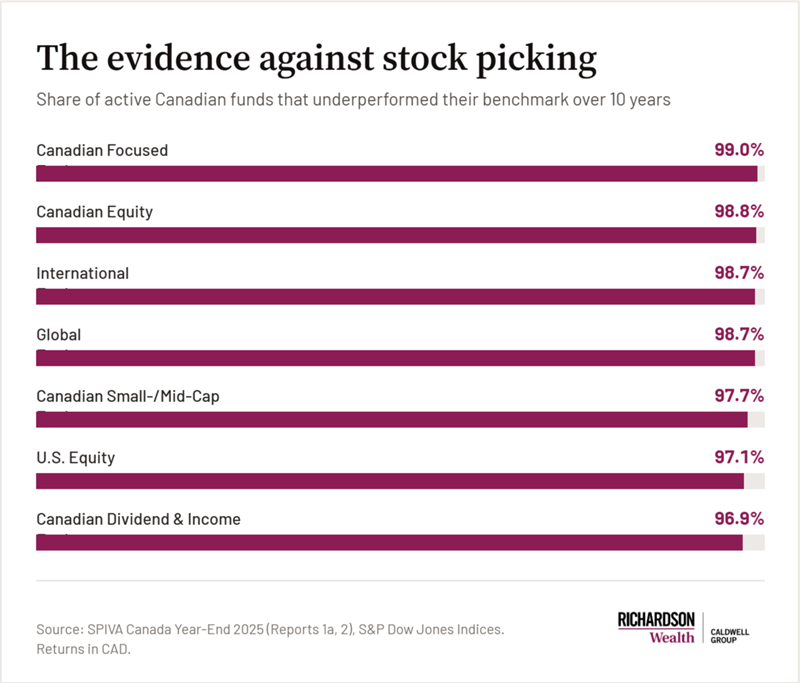
More than 96% fell short of the benchmark they were measured against.
Some do beat the market. That has never been in dispute. The harder question is the one an investor actually faces: can you identify them beforehand? Can you distinguish luck from skill?
Not reliably. Among U.S. stock funds ranking in the top quarter of their category over a five-year stretch, an average of roughly 23% were still in the top quarter over the five years that followed. Better than three-quarters of the winners did not repeat.
None of which is a failure of effort or of discipline. It is what happens when a process, however sound, depends on predicting something that resists prediction.
There is another way to build a process — one that rests on what can be demonstrated across decades of data, rather than on a view about what happens next. In September, we'll show you what that looks like: what we own, why, and how each decision traces back to evidence.
Register for the September 23 webinar · Guests welcome.
Sources: SPIVA Canada Year-End 2025 (Reports 1a, 2), S&P Dow Jones Indices, CAD. Persistence: Dimensional, March 2026, rolling five-year periods, 2006–2025.
The Most Valuable Thing About a Summer Job
If a young person in your family worked this summer, they earned something beyond the money. Employment income creates RRSP contribution room — room that carries forward indefinitely and becomes available decades later, when they are earning far more and a deduction is worth far more.
The catch is easy to miss: the room is only created once a return is filed. Someone earning a few thousand dollars owes no tax, so most don't bother. The income never reaches CRA, and no room is generated. Filing takes a few minutes and costs nothing. It is one of the higher-return administrative tasks available to a seventeen-year-old.
And if past summers have gone unfiled, this is recoverable. Prior-year returns can be filed late and CRA will update the room. Worth checking for the twenty-something who worked four summers and filed for none of them.
If you'd like help thinking through which accounts make sense for a young person in your family, or how a gift toward one might fit your own plan, we're glad to have that conversation.
One More Thing, While You’re Up There
We wrote in June about why cottages are more often lost to the conversation that never happened than to the tax bill.
August is when the family is actually in one place. If that conversation has been waiting for the right moment, this is the moment.
- Read the June piece: The Conversation Every Cottage Owner Needs to Have
- Download our cottage succession guide (PDF, English)
As always, we’re here if anything above raises a question about your own situation.
Justin D. Caldwell
Senior Investment Advisor, Portfolio Manager
Caldwell Group · Richardson Wealth Limited
Enjoyed this edition? Subscribe to Steady Gains.
The opinions expressed in this report are the opinions of the author and readers should not assume they reflect the opinions or recommendations of Richardson Wealth Limited or its affiliates. Assumptions, opinions and estimates constitute the author’s judgment as of the date of this material and are subject to change without notice. We do not warrant the completeness or accuracy of this material, and it should not be relied upon as such. Before acting on any recommendation, you should consider whether it is suitable for your particular circumstances and, if necessary, seek professional advice. Past performance is not indicative of future results. Insurance Services are offered through Richardson Wealth Insurance Services Limited (RWISL) in BC, AB, SK, MB, NWT, ON, QC, NB, NS, NL and PEI. Insurance products are not covered by the Canadian Investor Protection Fund (CIPF). RWISL is a wholly-owned subsidiary of Richardson Wealth Limited (RWL). RWL is a subsidiary of iA Financial Corporation Inc. and is not affiliated with James Richardson & Sons, Limited (JRSL). Richardson Wealth is a trademark of JRSL and RWL and its subsidiaries are licensed users of the mark. RWL is a member of CIPF.